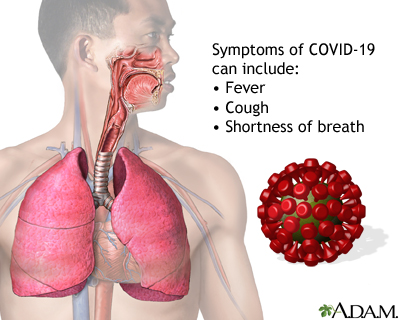
Coronavirus - 2019 discharge; SARS-CoV-2 discharge; COVID-19 recovery; Coronavirus disease - recovery; Recovering from COVID-19 DefinitionYou have recently been diagnosed with coronavirus disease 2019 (COVID-19). COVID-19 causes an infection in your lungs and may cause problems with other organs, including the kidneys, heart, and liver. Most often it causes a respiratory illness with fever, coughing, and shortness of breath. You may have mild to moderate symptoms or severe illness. This article is about how to recover from mild-to-moderate COVID-19 that does not require hospital treatment. People with severe illness will usually be treated in the hospital. Recovery from COVID-19 may take 10 to 14 days or longer depending on your symptoms. Some people have symptoms that go on for months even after they are no longer infected or able to spread the disease to other people. This is called long COVID. What to Expect at HomeYou tested positive for COVID-19 and are well enough to recover at home. While at home, try to separate yourself and stay away from other people both inside and outside your home. This can help protect others from getting the virus.
MEDICINES Your provider may prescribe antiviral medicines to help in your recovery, such as Paxlovid. Be sure to take your medicine as prescribed. Do not miss any doses. TAKE CARE OF YOURSELF It's important to manage your symptoms, get proper nutrition, and stay active as much as you can as you recover at home. Managing COVID-19 symptoms While recovering at home, keep track of your symptoms. Follow your provider's instructions and take medicines as prescribed. If you have severe symptoms, call 911 or the local emergency number. To help manage symptoms of COVID-19, try the following tips.
Nutrition COVID-19 symptoms such as loss of taste and smell, nausea, or tiredness can make it hard to want to eat. But eating a healthy diet is important for your recovery. These suggestions may help:
Physical Activity Even though you don't have a lot of energy, it's important to move your body every day. This will help you regain your strength.
WHEN TO RESUME NORMAL ACTIVITIES Once you start feeling better, you can go back to your normal activities if both of the following things are true:
Even though you feel better, you may still be able to spread the virus to others for several days. For this reason, once you go back to your normal activities, continue to protect others from illness by taking these steps for 5 days:
If your symptoms or fever return after resuming normal activities, you should go back to staying home and away from others. Once your fever and symptoms improve for more than 24 hours, you can resume activities while taking steps to protect others for 5 more days. When to Call the DoctorYou should contact your provider if your symptoms are getting worse. Call 911 or your local emergency number if you have:
ReferencesCenters for Disease Control and Prevention website. Respiratory Illnesses: respiratory virus guidance. www.cdc.gov/respiratory-viruses/guidance/index.html. Updated March 1, 2024. Accessed December 24, 2024. Centers for Disease Control and Prevention website. COVID-19: types of COVID-19 treatment. www.cdc.gov/covid/treatment/index.html. Updated December 20, 2024. Accessed December 24, 2024. Centers for Disease Control and Prevention website. Respiratory illnesses: masks and respiratory virus prevention. www.cdc.gov/respiratory-viruses/prevention/masks.html. Updated March 1, 2024. Accessed December 24, 2024. Centers for Disease Control and Prevention website. Respiratory illnesses: preventing the spread of respiratory viruses when you're sick. www.cdc.gov/respiratory-viruses/prevention/precautions-when-sick.html. Updated March 1, 2024. Accessed December 24, 2024. | ||
| ||
Review Date: 1/1/2025 Reviewed By: Linda J. Vorvick, MD, Clinical Professor Emeritus, Department of Family Medicine, UW Medicine, School of Medicine, University of Washington, Seattle, WA. Also reviewed by David C. Dugdale, MD, Medical Director, Brenda Conaway, Editorial Director, and the A.D.A.M. Editorial team. View References
The information provided herein should not be used during any medical emergency or for the diagnosis or treatment of any medical condition. A licensed medical professional should be consulted for diagnosis and treatment of any and all medical conditions. Links to other sites are provided for information only -- they do not constitute endorsements of those other sites. No warranty of any kind, either expressed or implied, is made as to the accuracy, reliability, timeliness, or correctness of any translations made by a third-party service of the information provided herein into any other language. All content on this site including text, images, graphics, audio, video, data, metadata, and compilations is protected by copyright and other intellectual property laws. You may view the content for personal, noncommercial use. Any other use requires prior written consent from Ebix. You may not copy, reproduce, distribute, transmit, display, publish, reverse-engineer, adapt, modify, store beyond ordinary browser caching, index, mine, scrape, or create derivative works from this content. You may not use automated tools to access or extract content, including to create embeddings, vectors, datasets, or indexes for retrieval systems. Use of any content for training, fine-tuning, calibrating, testing, evaluating, or improving AI systems of any kind is prohibited without express written consent. This includes large language models, machine learning models, neural networks, generative systems, retrieval-augmented systems, and any software that ingests content to produce outputs. Any unauthorized use of the content including AI-related use is a violation of our rights and may result in legal action, damages, and statutory penalties to the fullest extent permitted by law. Ebix reserves the right to enforce its rights through legal, technological, and contractual measures. | ||
| ||


 COVID-19


