| Pay attention to your systolic pressure! |
|


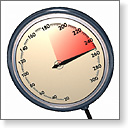
Recent studies have demonstrated the importance of the top number -- your systolic blood pressure. In fact, the systolic pressure may be a better indicator of your risk for heart disease and stroke than the bottom (diastolic) pressure, especially for people over the age of 50.
The American Heart Association stresses the importance of lowering your systolic pressure.
When only the top (systolic) number is elevated, doctors call this isolated systolic hypertension (ISH). The condition becomes increasingly common as people age. A person has ISH if the top reading is higher than 140 while the bottom reading is less than 90.
 |
|
In most people with ISH, the problem is either ignored or only partially treated.
When you go to the doctor, be sure to ask about both your systolic and diastolic blood pressure readings. If your blood pressure is too high, talk to your doctor about making some lifestyle changes and whether medication is necessary.
Treatment of high blood pressure should begin early to prevent organ damage. A growing number of young people have ISH -- and both young and old benefit greatly from early treatment.
Guidelines
If you have ISH, here are some points to consider:
- The goal for therapy is to bring the systolic number below 140.
- Lifestyle and dietary changes alone are often effective if the systolic blood pressure is above 160.
- Often, 2 or 3 medications are needed to successfully treat ISH.
- In people with diabetes or kidney disease, the goal for therapy is to bring the systolic number below 130. Diabetes and kidney disease is associated with greater complications when combined with hypertension. Having diabetes makes it more difficult to treat ISH.
- In people with kidney failure or heart failure, blood pressure should be kept at the lowest possible level without getting symptoms such as lightheadedness.
- Blood pressure should be lowered slowly in older people with longstanding, severe systolic high blood pressure.
- For some people, blood pressure goals may take longer to reach. This may be referred to as "resistant hypertension."
 |
Reviewed By: Steven Kang, MD, Division of Cardiac Pacing and Electrophysiology, East Bay Arrhythmia, Cardiovascular Consultants Medical Group, Oakland, CA. Review provided by VeriMed Healthcare Network. Also reviewed by David Zieve, MD, MHA, Medical Director, A.D.A.M., Inc.
© 1997- A.D.A.M., a business unit of Ebix, Inc. Any duplication or distribution of the information contained herein is strictly prohibited.
 All rights reserved.