 |
  |
 Ultrasound - Series |
Ultrasound
An ultrasound is a diagnostic or screening procedure that uses high-frequency sound waves to create a picture of internal body structures, such as a developing fetus. It may also be called an ultrasound scan, sonogram, or ultrasonography.
What Is It?
Ultrasound uses high-frequency sound waves to detect internal body structures, much like sonar aboard a ship can locate a school of dolphins.
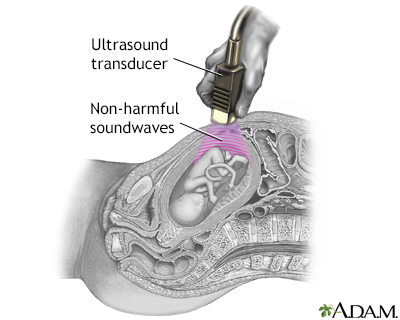
An instrument called a transducer emits sound waves that bounce or echo off internal organs. This information is relayed to a computer, which produces an image on a nearby screen.
The routine use of ultrasound during pregnancy is somewhat controversial. Some health professionals believe it should be used to screen every pregnant woman for potential problems, while others say it should be reserved for use as a diagnostic tool when other tests or exams raise concerns. These days ultrasound machines are widely available, and most women have at least one sonogram during their pregnancy.
Ultrasound Is Often Used To:
- Confirm a pregnancy.
- Spot multiple fetuses (twins, triplets, or more).
- Assess the fetus' age, size, maturity, or condition.
- Monitor the fetus' growth.
- Detect conditions such as spina bifida or malformations of the kidney, brain, heart, intestines, and limbs.
- Detect poly- or oligohydramnios, the presence of too much or too little amniotic fluid.
- Assess the fetus' position (see delivery presentations).
- Identify the location of the placenta.
- Guide procedures such as amniocentesis, Percutaneous Umbilical Cord Blood Sampling (PUBS), or Chorionic Villus Sampling (CVS).
How Can I Prepare?
A full bladder helps your doctor or technician get a clearer picture of the baby (especially during the early months of pregnancy), so she may ask you to drink a lot of water and refrain from urinating for an hour or two before the ultrasound.
What Will Happen?
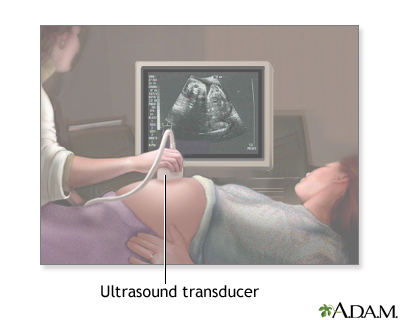
Ultrasound is done at your doctor's office or a hospital. You'll change into a hospital gown or simply roll your skirt or pants away from your belly and lie on your back on an exam table. Next, the technician spreads a special conducting gel on your belly and passes a hand-held transducer over it using gentle pressure. For ultrasounds done very early in pregnancy before the uterus rises up over the pelvic bone, or when the doctor needs to get a better look at the cervix, a tampon-sized transducer is inserted into the vagina.
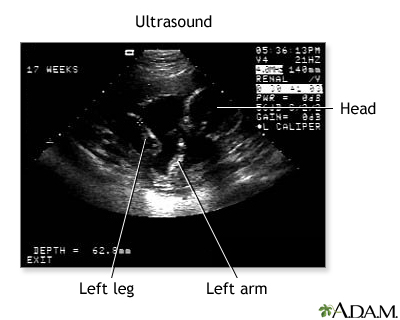
The technician (along with your doctor) will review the images of your uterus and fetus on the computer screen, and she may even print out an image or two as a keepsake for you. Ultrasound images are hard for the untrained eye to decipher, so don't be shy about asking the technician to explain the picture for you. The entire process usually takes just a few minutes, and you shouldn't feel any discomfort while it's happening.
An ultrasound can supply vital information about your pregnancy and your baby's health. If a problem is revealed, it may also provide insight into possible treatment options. Of course, the chance that an ultrasound will correctly identify - or rule out - a particular medical condition depends on many different factors, not least of which is the skill of the person performing the procedure.
What Are The Risks?
There are no health risks associated with ultrasound, although no one knows for sure what the possible long-term effects may be for you or your child. Ultrasound is believed to be one of the safest procedures performed during pregnancy.
When you have an ultrasound, your doctor may also identify minor variations in your baby’s anatomy that are associated with genetic problems like Down syndrome. These variations, called markers, aren’t dangerous for your baby, but may lead to recommendations for further tests, such as amniocentesis.
For example, some fetuses have an area in the heart that looks bright on ultrasound. The heart functions completely normally, but this spot, called an echogenic intracardiac focus, or EIF, is often seen in fetuses with Down syndrome. The difficulty is that about 1 in 20 normal fetuses will have an EIF too.
It’s important to realize, before you go for an ultrasound, that you may get some confusing information about the risk of genetic problems. This can be stressful for you and your partner. Ask to meet with a genetic counselor to clarify your risk and better understand what various findings mean.
Frequently Asked Questions
Q: Do I have to have an ultrasound during my pregnancy?
A: Having an ultrasound is optional, though your doctor may strongly suggest that you get one if she suspects a problem. Many doctors also think that an ultrasound is now part of routine care.
Q: Does ultrasound use radiation?
A: No. Since it uses sound waves to create an internal image, an ultrasound is a much safer diagnostic tool during pregnancy than an X-ray.
Q: Will an ultrasound tell me if I'm having a boy or a girl?
A: If it's done at 18 weeks or later, ultrasound may pick up a clear image of your baby's genitals - provided he (or she) cooperates, of course. Occasionally, though, the doctor makes a mistake – so save the receipts for all those cute pink or blue outfits, just in case!
Reviewed By: Irina Burd, MD, PhD, Maternal Fetal Medicine, Johns Hopkins University, Baltimore, MD. Review provided by VeriMed Healthcare Network.
© 1997- A.D.A.M., a business unit of Ebix, Inc. Any duplication or distribution of the information contained herein is strictly prohibited.
 All rights reserved.