


Heart catheterization
Introduction
The purpose of this tool is to help you decide whether or not to have a heart catheterization. When making a decision like this, you must balance:
- The reasons for having the test
- The potential health risks, drawbacks, or limitations of the procedure
- Whether there are alternative procedures that may be more appropriate
- Cost
This tool is not a substitute for professional medical care and advice. Work with your doctor to help you make this decision. A second opinion from another doctor may be valuable. There is usually no exact “right” or “wrong” answer.
Your physician may make certain recommendations to you. However, the final decision about whether to have this test rests with you.
What is the test?
Heart catheterization involves passing a catheter (a thin flexible tube) into the right or left side of the heart. In general, this procedure is performed to obtain diagnostic information about the heart or its blood vessels or to provide treatment in certain types of heart conditions.
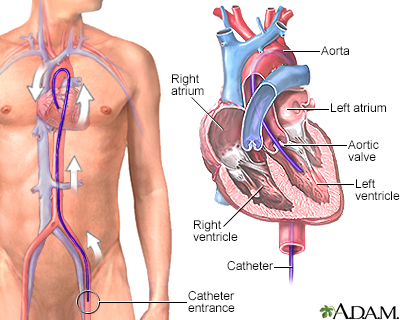
Heart catheterization can be used to determine pressure and blood flow in the heart's chambers, collect blood samples from the heart, and examine the arteries of the heart with an x-ray technique called fluoroscopy. Fluoroscopy provides immediate visualization of the x-ray images on a screen and a permanent record of the procedure.
Key points
Benefits:
- Heart catheterization is the standard test for evaluating the heart’s blood supply, internal pressures, and function.
- Heart catheterization allows health care providers to rapidly assess any narrowing (or blockages) in the arteries that supply the heart with blood.
- Heart catheterization allows health care providers to directly see the heart arteries, while a treadmill stress test lets a doctor only estimate how well blood is flowing to the heart.
- Heart catheterization allows health care providers to determine possible changes in the heart’s arteries.
- Heart catheterization may allow doctors to determine the degree of any narrowing (stenosis) of the heart valves.
- Heart catheterization allows doctors to determine if there are areas of the heart that need surgery to receive better blood flow.
- Heart catheterization allows your doctor to proceed with angioplasty and stenting if your blocked or narrowed artery needs immediate attention.
Risks:
- Some bleeding or bruising at the site of the catheter insertion is common.
- IV dye (contrast) is used during the test. The dye may be toxic to the kidneys, particularly in patients with kidney disease.
- Rarely, stroke, heart attack, or death may occur.
How much time this decision tool will take
5 - 10 minutes
What this tool will provide
- A personalized list of factors for you to weigh
- Questions to ask your doctor
- Alternatives to this test
- Recommended reading
|
Review Date:
9/19/2010 Reviewed By: David C. Dugdale, III, MD, Professor of Medicine, Division of General Medicine, Department of Medicine, University of Washington School of Medicine. Also reviewed by David Zieve, MD, MHA, Medical Director, A.D.A.M., Inc. |
- Achenbach S and Daniel WG. Computed tomography of the heart. In: Libby P, Bonow RO, Mann DL, Zipes DP, eds. Braunwald's Heart Disease: A Textbook of Cardiovascular Medicine. 8th ed. Saunders; 2007:chap 18.
- Anderson JL, Adams CD, Antman EM, Bridges CR, Califf RM, Casey DE Jr, et al. ACC/AHA 2007 guidelines for the management of patients with unstable angina/non-ST-Elevation myocardial infarction: a report of the American College of Cardiology/American Heart Association Task Force on Practice Guidelines (Writing Committee to Revise the 2002 Guidelines for the Management of Patients With Unstable Angina/Non-ST-Elevation Myocardial Infarction) developed in collaboration with the American College of Emergency Physicians, the Society for Cardiovascular Angiography and Interventions, and the Society of Thoracic Surgeons endorsed by the American Association of Cardiovascular and Pulmonary Rehabilitation and the Society for Academic Emergency Medicine. J Am Coll Cardiol. 2007 Aug 14;50(7):e1-e157.
- Antman EM. ST-Elevation myocardial infarction: management. In: Libby P, Bonow RO, Mann DL, Zipes DP, eds. Braunwald's Heart Disease: A Textbook of Cardiovascular Medicine. 8th ed. Saunders; 2007:chap 51.
- Fraker TD Jr, Fihn SD, Gibbons RJ, Abrams J, Chatterjee K, Daley J, et al. 2007 chronic angina focused update of the ACC/AHA 2002 Guidelines for the management of patients with chronic stable angina: a report of the American College of Cardiology/American Heart Association Task Force on Practice Guidelines Writing Group to develop the focused update of the 2002 Guidelines for the management of patients with chronic stable angina. Circulation. 2007 Dec 4;116(23):2762-72. Epub 2007 Nov 12.
- Gaziano JM,Manson, JE, Ridker PM. Primary and secondary prevention of coronary heart disease. In: Libby P, Bonow RO, Mann DL, Zipes DP, eds. Braunwald's Heart Disease: A Textbook of Cardiovascular Medicine. 8th ed. Saunders; 2007:chap 45.
- Otto CM, Bonow RO. Valvular heart disease. In: Libby P, Bonow RO, Mann DL, Zipes DP, eds. Braunwald's Heart Disease: A Textbook of Cardiovascular Medicine. 8th ed. Saunders; 2007:chap 62.
© 1997- A.D.A.M., a business unit of Ebix, Inc. Any duplication or distribution of the information contained herein is strictly prohibited.
 All rights reserved.