


Ultrasound
Introduction
The purpose of this tool is to help you decide whether or not to have an ultrasound. When making a decision like this, you must balance:
- The reasons for having the test
- The potential health risks, drawbacks, or limitations of the procedure
- Whether there are alternative procedures that may be more appropriate
- Cost
This tool is not a substitute for professional medical care and advice. Work with your doctor to help you make this decision. A second opinion from another doctor may be valuable. There is usually no exact “right” or “wrong” answer.
Your physician may make certain recommendations to you. However, the final decision about whether to have this test rests with you.
What is the test?
Ultrasound involves the use of high-frequency sound waves to create images that allow your health care provider to see various organs in the body. The machine sends out high-frequency sound waves, which reflect off body structures. A computer receives these reflected waves and uses them to create a picture. Unlike with an x-ray, there is no ionizing radiation exposure with this test.

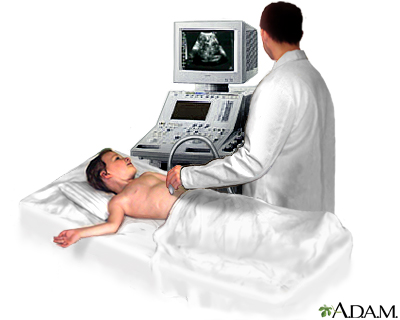
You will be lying down for the procedure. A clear, water-based conducting gel is applied to the skin over the area being examined to help with the transmission of the sound waves. A handheld probe called a transducer is then moved over the area being examined. You may be asked to change position so that other areas can be examined.
Key points
- Sometimes the handheld probe needs to be inserted into the body, rather than simply being passed over the skin.
- Because ultrasound does not use ionizing radiation it is safer than a CT scan.
- There are no risks with the use of ultrasound.
- Ultrasound is the standard way to evaluate a pregnancy.
- Ultrasound is the standard way to evaluate the female pelvic structures.
- Ultrasound is the standard way to evaluate the gallbladder and bile ducts.
How much time this decision tool will take
5 - 10 minutes
What this tool will provide
- A personalized list of factors for you to weigh
- Questions to ask your doctor
- Alternatives to this test
- Recommended reading
|
Review Date:
9/12/2010 Reviewed By: Linda J. Vorvick, MD, Medical Director, MEDEX Northwest Division of Physician Assistant Studies, University of Washington, School of Medicine. Also reviewed by David Zieve, MD, MHA, Medical Director, A.D.A.M., Inc. |
- Imaging benign and malignant disease of the gallbladder. Radiol Clin North Am. December 2002;40(6):1307-23, vi.
- Lentz GM. Differential diagnosis of major gynecologic problems by age group: vaginal bleeding, pelvic pain, pelvic mass. In: Katz VL, Lentz GM, Lobo RA, Gershenson DM, eds. Comprehensive Gynecology. 5th ed. St. Louis, Mo: Mosby 2007: chap 8.
- Lobo RA. Abnormal uterine bleeding: ovulatory and anovulatory dysfunctional uterine bleeding, management of acute and chronic excessive bleeding. In: Katz VL, Lentz GM, Lobo RA, Gershenson DM, eds. Comprehensive Gynecology. 5th ed. St. Louis, Mo: Mosby 2007: chap 37.
- Shah K, Wolfe R. Hepatobiliary ultrasound. Emerg Med Clin North Am. August 2004;22(3):661-73, viii.
© 1997- A.D.A.M., a business unit of Ebix, Inc. Any duplication or distribution of the information contained herein is strictly prohibited.
 All rights reserved.